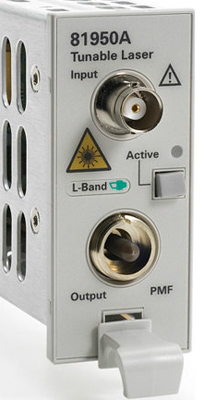
Keysight (Agilent) 81950A CALIBRATION and Keysight (Agilent) 81950A REPAIR

 
A calibration by Custom-Cal is performed by engineers with extensive OEM experience. We have the expertise and the necessary standards to perform the Keysight (Agilent) 81950A Calibration, onsite calibration may be available. We specialize in quick turnaround times and we can handle expedited deliveries upon request.

Need another Tunable Laser Source (TLS)?
Shop for Comparable Products on our
 used Tunable Laser Source (TLS) page or new Tunable Laser Source (TLS) page

 
   Keysight (Agilent) 81950A   Description / Specification:   Spec Sheet 
Keysight (Agilent) 81950A 1527-1565 or 1570-1608 nm opt based Tunable Laser Module

The Agilent 81950A compact tunable laser source is step-tunable for setting channel frequencies within any grid in the C- or L-band. With high output power up to +15 dBm, narrow linewidth of 100 kHz, and offset grid fine-tuning capability, the 81950A is a universal source for realistic loading of the latest transmission systems. It is available with C-band or L-band wavelength coverage. It can reach any wavelength point within its specified wavelength range just like all other Agilent tunable lasers. In system loading applications, it may be preferable to grid-tune the laser like system transmitters, simply by changing the channel index. The channel grid is adjustable to standard ITU-T grid spacing like 50 GHz, and to arbitrary grids. Likewise, the zero frequency (base channel) of the chosen grid is adjustable. A 12 GHz fine-tuning range allows de-tuning the frequency. Specifications. Wavelength (frequency) range: 1527.6 nm to 1565.50 nm (Option 210), 1570.01 nm to 1608.76 nm (Option 201). Frequency resolution: 100 MHz, 0.8 pm at 1550 nm. Tuning time: Typical < 30 sec. Fine tuning range: Typical ± 6 GHz. Fine tuning resolution: Typical 1 MHz. Absolute wavelength (frequency) accuracy: ± 22 pm (± 2.5 GHz). Relative wavelength (frequency) accuracy: ± 12 pm (± 1.5 GHz). Wavelength (frequency) repeatability: Typical ± 2.5 pm (± 0.3 GHz). Wavelength (frequency) stability (typical, over 24 hours): Typical ± 2.5 pm (± 0.3 GHz), 24 hours. Linewidth (typical), SBS suppression off: < 100 kHz. Maximum output power: = +13.5 dBm (typical = +15 dBm). Power stability Typical: ± 0.03 dB over 1 hour. Power flatness: Typical ± 0.2 dB (full wavelength range). Power repeatability: Typical ± 0.08 dB. Side-mode suppression ratio: Typical 50 dB. Relative intensity noise (RIN): Typical -145 dB/Hz (10 MHz to 40 GHz).


Standard Calibration $780.00 *
Click on Logo for More Prices
*This is a Web introductory price for one calibration of the Keysight (Agilent) 81950A. Price does not in most cases include measurement performance data. Pricing does include NIST traceable calibration and issue of a calibration certificate and calibration label. Pricing may vary slightly due to volume and location of laboratory supporting calibration. Volume pricing may apply. On-site fees may apply depending on logistics, location and volume of work to be completed during the visit.


Related Optical Terms and Definitions. For a complete list go to our  Terms and Definitions Page.

Chromatic Dispersion
Chromatic Dispersion is a broadening of the input signal as it travels down the length of the fiber. Chromatic Dispersion results from a variation in propagation delay with wavelength, and is affected by fiber materials and dimensions.

Detector
A Detector is a signal conversion device that converts power from one form to another, such as from optical power to electrical power

Jitter
Jitter in technical terms is the deviation in or displacement of some aspect of the pulses in a high-frequency digital signal. Jitter is the time variation of a periodic signal in electronics and telecommunications, often in relation to a reference clock source. Jitter may be observed in characteristics such as the frequency of successive pulses, the signal amplitude, or phase of periodic signals. Jitter is a significant, and usually undesired, factor in the design of almost all communications links (e.g., USB, PCI-e, SATA, OC-48). In clock recovery applications it is called timing jitter.

Polarization Mode Dispersion (PMD)
Polarization mode dispersion (PMD) is a form of modal dispersion where two different polarizations of light in a waveguide, which normally travel at the same speed, travel at different speeds due to random imperfections and asymmetries, causing random spreading of optical pulses. It is he difference between the maximum and minimum values of loss typically measured in ps/km^1/2.


Please contact us for your Keysight (Agilent) 81950A CALIBRATION and/or Keysight (Agilent) 81950A 1527-1565 or 1570-1608 nm opt based Tunable Laser Module REPAIR

I'm interested in: 
Calibration Type (Select one):
Repair Information:
 Serial Number:

 Is there any physical damage?  
 If yes, describe:


What is the description of the problem?

How/when did the problem start?


 (*) Required Fields    For formal quote please fill in all fields.
Company:
From (Email):*
Contact Name:*
Country:*
Address 1:
Address 2:
City:
State/Territory/Province: *
Zip/Postal Code:
Phone:*

Comment: