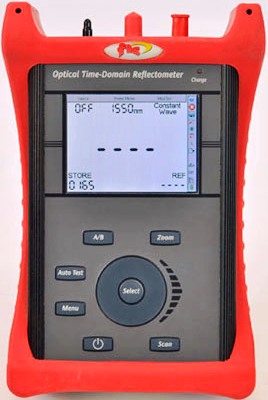
FIS OVX-1315 CALIBRATION and FIS OVX-1315 REPAIR

 
A calibration by Custom-Cal is performed by engineers with extensive OEM experience. We have the expertise and the necessary standards to perform the FIS OVX-1315 Calibration, onsite calibration may be available. We specialize in quick turnaround times and we can handle expedited deliveries upon request.

Need another OTDR? Shop for Comparable Products on our   new OTDR page

 
   FIS OVX-1315   Description / Specification:    
FIS OVX-1315 1310/1550 nm Singlemode OTDR

The FIS OVX-1315 1310 / 1550 nm Singlemode OTDR incorporates all the features that are truly needed in hand-held OTDRs. Speed, dynamic range, easy to read color display, rugged package, short dead Zone, light weight, and easy to use. All these aspects of the Advanced OTDR are what makes it ideal for every day use in the field on a wide variety of networks. This OTDR can be operated by the novice while at the same time be appreciated by the seasoned user. Testing is made simple and fast with the press of the Auto Test button. Examine the trace using the straight forward zoom feature, A/B cursor selection button and touch-wheel. Zero in on events fast with the powerful Event Selection feature or with the event analysis table. The Advanced OTDR’s abundant dynamic Range and a 2 meter dead zone, makes it ideal for links up to 240km as well as being perfect for short LAN links within the facility. Weighing in at just 2.0 pounds with a hardened enclosure this OTDR is ideal for all conditions. The rubber boot with bail will add protection and provides a the ideal angle for viewing the display while operation on a work bench. Specifications. Wavelength: 1310 / 1550 nm ±20nm. Dynamic Range: 32/30dB SM. Pulse Width: 20 to 10,000 ns. Units of Measurement: km, kf. Event Dead zone: 2m. Attenuation Dead Zone: 5m. Resolution: 0.25 to 64 m. Distance Uncertainty: ±(0.75m + 0.005% x distance + sampling resolution). Distance Range: 1-240km SM. Typical Real-time Refresh Rate: 4 Hz. Group Index of Refraction (GIR): 1.024 to 2.048. Linearity: ± .05 dB/dB. Memory Capacity: 1000. Memory Type: Internal and Flash Drive. Visible Light Source; Emitter Type: Laser. Wavelength: 650 nm ±5 nm. Output Power: 1 mW Max.


Standard Calibration $405.00 *
*This is a Web introductory price for one calibration of the FIS OVX-1315. Price does not in most cases include measurement performance data. Pricing does include NIST traceable calibration and issue of a calibration certificate and calibration label. Pricing may vary slightly due to volume and location of laboratory supporting calibration. Volume pricing may apply. On-site fees may apply depending on logistics, location and volume of work to be completed during the visit.


Related Optical Terms and Definitions. For a complete list go to our  Terms and Definitions Page.

Bandwidth
Bandwidth is the difference between the upper and lower frequencies in a contiguous set of frequencies within which a fiber optic component, link or network will operate.

Extinction Ratio (ER)
Extinction Ratio is the ratio of two optical power levels, of a digital signal generated by an optical source, (example a laser diode), where P1 is the optical power level generated when the light source is "on," and P0 is the power level generated when the light source is "off." The extinction ratio may be expressed as a fraction, in dB, or as a percentage.

Optical Signal-to-noise Ratio (OSNR)
Optical Signal-to-noise ratio is the ratio between the signal power and the noise power in a given bandwidth. Most commonly a reference bandwidth of 0.1 nm is used. This bandwidth is independent from the modulation format, the frequency and the receiver. For instance a OSNR of 20dB/0.1nm could be given, even the signal of 40 GBit DPSK would not fit in this bandwidth. OSNR is measured with a Optical Spectrum Analyzer. It is generally measured at the wavelength of interest.

Repeatability
Repeatability is the variation in a number of repeated measured quantities when measurement conditions are changed and restored. The value corresponds to half the spread between the minimum and maximum value measured.

Wavelength Repeatability
Wavelength Repeatability is the random uncertainty in reproducing a wavelength after detuning and re-setting the wavelength. The wavelength repeatability is ± half the span between the maximum and the minimum value of all actual values of these wavelengths. Example test condition: uninterrupted TLS output power, constant power level, temperature within operating temperature range, coherence control off, short time span. Note: NOTE The long-term wavelength repeatability can be obtained by taken the wavelength repeatability and wavelength stability into account.


Please contact us for your FIS OVX-1315 CALIBRATION and/or FIS OVX-1315 1310/1550 nm Singlemode OTDR REPAIR

I'm interested in: 
Calibration Type (Select one):
Repair Information:
 Serial Number:

 Is there any physical damage?  
 If yes, describe:


What is the description of the problem?

How/when did the problem start?


 (*) Required Fields    For formal quote please fill in all fields.
Company:
From (Email):*
Contact Name:*
Country:*
Address 1:
Address 2:
City:
State/Territory/Province: *
Zip/Postal Code:
Phone:*

Comment: