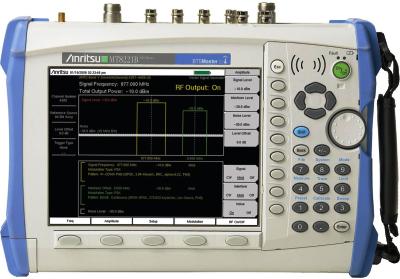
ANRITSU MT8221B CALIBRATION and ANRITSU MT8221B REPAIR

 
A calibration by Custom-Cal is performed by engineers with extensive OEM experience. We have the expertise and the necessary standards to perform the ANRITSU MT8221B Calibration, onsite calibration may be available. We specialize in quick turnaround times and we can handle expedited deliveries upon request.

Need another Cellular Test Set? Shop for Comparable Products on our   new Cellular Test Set page

 
   ANRITSU MT8221B   Description / Specification:   Spec Sheet 
ANRITSU MT8221B 4 GHz BTS Master High Perf. Handheld Base Station Analyzer

The Anritsu MT8221B 4 GHz BTS Master High Performance Handheld Base Station Analyzer has been designed to support 4G standards and installed 2G/3G networks. The MT8221B's platform provides a 20 MHz demodulation capability to support LTE bandwidths from 1.4 to 20 MHz. It also features a 30 MHz Zero-Span IF Output for external demodulation of virtually any other wideband signal. In addition, a Vector Signal Generator option is available for comprehensive receiver testing capability with the flexibility to generate two modulated signals plus noise. Cable and Antenna Analyzer Highlights; Measurements: RL, VSWR, Cable Loss, DTF, Phase, Gain. 2-port Gain Measurement Uncertainty: < 0.45 dB. 2-port Dynamic Range: > 80 dB. RF Immunity: +17 dBm on-channel, +10 dBm on-frequency. Calibration: OSL and FlexCal. Bias Tee: 32 V internal. Spectrum and Interference Analyzer Highlights; Measurements: Occupied Bandwidth, Channel Power, ACPR, C/I. Interference Analyzer: Spectrogram, Signal Strength, RSSI, Signal ID. Dynamic Range: > 95 dB in 1 Hz RBW. DANL: -163 dBm in 1 Hz RBW. Phase Noise: -100 dBc/Hz @ 10 kHz offset. Frequency Accuracy: ± 25 ppb with GPS On.
Specifications .

Cable and Antenna Analyzer.
Frequency Range: 400 MHz to 4 GHz.
Frequency Accuracy: ± 3.0 ppm.
Frequency Resolution: 1 kHz (RF immunity low), 100 kHz (RF immunity high).
Output Power High: -7 dBm, typical, 1 or 2-port.
Output Power Low: -40 dBm, typical, 2-port.
Dynamic Range: 400 MHz to 3.0 GHz 80 dB, > 3.0 GHz to 4.0 GHz 70 dB.

Spectrum Analyzer.
Frequency Range: 150 kHz to 7.1 GHz (usable to 0 Hz).
Maximum Continuous Input: +30 dBm.
Tuning Resolution: 1 Hz.
Frequency Span Accuracy: ± 0.3 ppm (25 °C ± 25 °C) + aging, 10 Hz to 7.1 GHz including zero span.
Sweep Time: Minimum 100 ms, 10 µs to 600 s in zero span.
Resolution Bandwidth (RBW): 1 Hz to 3 MHz in 1-3 sequence ±10 % (1 MHz max in zero-span) (-3 dB bandwidth).

Power Meter.
Frequency Range: 10 MHz to 7.1 GHz.
Span: 1 kHz to 100 MHz.
Display Range: -140 dBm to +30 dBm, <= 40 dB span.


Standard Calibration $1,135.00 *
Click on Logo for More Prices
*This is a Web introductory price for one calibration of the ANRITSU MT8221B. Price does not in most cases include measurement performance data. Pricing does include NIST traceable calibration and issue of a calibration certificate and calibration label. Pricing may vary slightly due to volume and location of laboratory supporting calibration. Volume pricing may apply. On-site fees may apply depending on logistics, location and volume of work to be completed during the visit.


Related Communication Terms and Definitions. For a complete list go to our  Terms and Definitions Page.

Bandwidth
Bandwidth is the difference between the upper and lower frequencies in a contiguous set of frequencies within which a fiber optic component, link or network will operate.

Multimode Fiber
Multimode Fiber has a large core (almost always 62.5 microns - a micron is one one millionth of a meter - but sometimes 50 microns) and is used with LED sources at wavelengths of 850 and 1300 nm for short distance, lower speed networks like LANs. Both multimode and singlemode fiber have an outside diameter of 125 microns - about 5 thousandths of an inch - just slightly larger than a human hair.

SDH
Synchronous Digital Hierarchy (SDH) is an international digital telecommunications network hierarchy which standardises transmission around the bit rate of 51.84 megabits per second, which is also called STS-1. Multiples of this bit rate comprise higher bit rate streams. Thus STS-3 is 3 times STS-1, STS-12 is 12 times STS-1, and so on. STS-3 is the lowest bit rate expected to carry ATM traffic, and is also referred to as STM-1 (Synchronous Transport Module-Level 1). The SDH specifies how payload data is framed and transported synchronously across optical fibre transmission links without requiring all the links and nodes to have the same synchronized clock for data transmission and recovery.


Please contact us for your ANRITSU MT8221B CALIBRATION and/or ANRITSU MT8221B 4 GHz BTS Master High Perf. Handheld Base Station Analyzer REPAIR

I'm interested in: 
Calibration Type (Select one):
Repair Information:
 Serial Number:

 Is there any physical damage?  
 If yes, describe:


What is the description of the problem?

How/when did the problem start?


 (*) Required Fields    For formal quote please fill in all fields.
Company:
From (Email):*
Contact Name:*
Country:*
Address 1:
Address 2:
City:
State/Territory/Province: *
Zip/Postal Code:
Phone:*

Comment: