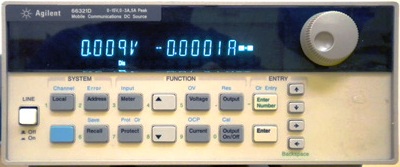
Keysight (Agilent) 66321D CALIBRATION and Keysight (Agilent) 66321D REPAIR

 
A calibration by Custom-Cal is performed by engineers with extensive OEM experience. We have the expertise and the necessary standards to perform the Keysight (Agilent) 66321D Calibration, onsite calibration may be available. We specialize in quick turnaround times and we can handle expedited deliveries upon request.

Need another DC Power Supply?
Shop for Comparable Products on our
 used DC Power Supply page

 
   Keysight (Agilent) 66321D   Description / Specification:    
Keysight (Agilent) 66321D Single-Output Mobile Communication DC Source, DVM

The Agilent 66321D Single Output Mobile Communications DC Source with addition of a built-in digital voltmeter. Offers a built-in advanced measurement system to accurately measure battery current drains when the device operates in different modes (such as talk mode, active mode, standby mode, and off/sleep mode). Measurements made during these modes are critical for ensuring that your devices are operating properly and that you are getting the most out of the battery. The Agilent 66321D is recommended when you need to provide power as a replacement to your device’s main battery during testing. Specifications. Voltage: 0 to 15 V. Current: 0 to 3 A. Peak current for up to 7 ms: 5 A. Programming accuracy at 25°C ±5°C (% of setting plus fixed): Voltage 0.05% + 10 mV, Current 0.05% + 1.33 mA. Ripple and Noise (20 Hz to 20 MHz): Voltage rms 1 mV (peak-to-peak 6 mV), Current rms 2 mA. DC measurement accuracy: Voltage 0.03% + 5 mV, -3 A to + 5 A 0.2% 0.5 mA, -1 A to + 1 A 0.1% 0.2 mA, 20 mA to + 20 mA range 0.1% + 2.5 µA. Dynamic measurement system: Buffer size 4096 points, Sampling interval 15 µs - 31,200 s. Transient response time <20 µs. Programmable output resistance: Range 40 m-Ohm to 1 Ohm, Programming accuracy 0.5% + 2 m-Ohm. Voltmeter input: -25 to +25 Vdc. DC readback accuracy (at 25°C ±5°C): 0.04% + 5 mV. AC + DC readback accuracy (at 25°C ±5°C) with DC plus a sinewave input > 25 mV rms: 1% + 5 mV (60 Hz to 10 kHz). Command Processing Time: Average time required for the output voltage to begin to change following receipt of GPIB data is 4 ms (with display disabled). Options. Opt 004; Make "Hi Compensation Mode" as default setting. Opt 007; Extra 5-pin output connectors (2 x p/n 0360-2604. Opt 052; 14565A Device Characterization Software. Opt 053; Add 14565A Device Characterization Software with Battery Drain Analysis. Opt 100; 87 to 106 Vac, 47 to 63 Hz. Opt 220; 191 to 233 Vac, 47 to 63 Hz. Opt 230; 207 to 253 Vac, 47 to 63 Hz. Opt 8ZL; Include feet.


Standard Calibration $220.00 *
Click on Logo for More Prices
*This is a Web introductory price for one calibration of the Keysight (Agilent) 66321D. Price does not in most cases include measurement performance data. Pricing does include NIST traceable calibration and issue of a calibration certificate and calibration label. Pricing may vary slightly due to volume and location of laboratory supporting calibration. Volume pricing may apply. On-site fees may apply depending on logistics, location and volume of work to be completed during the visit.


Related Bench Equipment Terms and Definitions. For a complete list go to our  Terms and Definitions Page.

Channel Bandwidth
Channel Bandwidth is the bandwidth over which power is measured. This is usually the bandwidth in which almost all of the power of a signal is contained.

Jitter
Jitter in technical terms is the deviation in or displacement of some aspect of the pulses in a high-frequency digital signal. Jitter is the time variation of a periodic signal in electronics and telecommunications, often in relation to a reference clock source. Jitter may be observed in characteristics such as the frequency of successive pulses, the signal amplitude, or phase of periodic signals. Jitter is a significant, and usually undesired, factor in the design of almost all communications links (e.g., USB, PCI-e, SATA, OC-48). In clock recovery applications it is called timing jitter.

Overshoot
Overshoot is the distortion that follows a major transition; the difference between the peak power point and the pulse-top amplitude computed as a percentage of the pulse-top amplitude.

Rise Time
Rise time refers to the time required for a signal to change from a specified low value to a specified high value, usually 10 and 90 percent of pulse-top amplitude (vertical display is linear power).


Please contact us for your Keysight (Agilent) 66321D CALIBRATION and/or Keysight (Agilent) 66321D Single-Output Mobile Communication DC Source, DVM REPAIR

I'm interested in: 
Calibration Type (Select one):
Repair Information:
 Serial Number:

 Is there any physical damage?  
 If yes, describe:


What is the description of the problem?

How/when did the problem start?


 (*) Required Fields    For formal quote please fill in all fields.
Company:
From (Email):*
Contact Name:*
Country:*
Address 1:
Address 2:
City:
State/Territory/Province: *
Zip/Postal Code:
Phone:*

Comment: