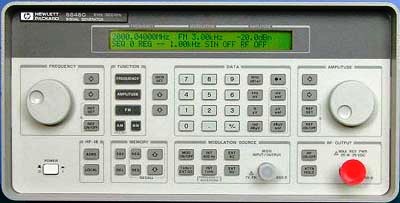
Keysight (Agilent) 8648C REPAIR and Keysight (Agilent) 8648C CALIBRATION

 
Custom-Cal has a high success rate in the repair of the Keysight (Agilent) 8648C. A calibration by Custom-Cal is performed by engineers with extensive OEM experience. We have the expertise and the necessary standards to perform the Keysight (Agilent) 8648C Calibration, onsite calibration may be available. We specialize in quick turnaround times and we can handle expedited deliveries upon request.

Need another Signal Generator?
Shop for Comparable Products on our
 used Signal Generator page

 
   Keysight (Agilent) 8648C   Description / Specification:    
Keysight (Agilent) 8648C 3200 MHz Synthesized Signal Generator

The HP 8648C 3200 MHz synthesized signal generator delivers solid performance and reliability. This signal generator provides the features and performance needed for semi-automated receiver testing and for use in a variety of general-purpose applications over a 9 kHz to 3200 MHz frequency range. The HP 8648C provides ±1 dB absolute amplitude accuracy up to 2.5 GHz. It offers ultra stable dc FM, with ±500 Hz carrier frequency accuracy below frequencies of 1001 MHz, and low RF leakage. Applications such as receiver tuning and alignment benefit from the simple user interface. These signal generators are so easy to learn and use that experienced operators are no longer required. With 300 full storage registers and ten user-definable sequences, the signal generator easily adapts to any test procedure. Once setups are stored in registers, operators can quickly sequence through them, either from the front panel or through a remote keypad (HP 83300A). In addition, the HP 83301A memory interface provides the means to transfer register information from one HP 8647/48 to another. Specifications. Frequency: 9 kHz to 3200 MHz. Resolution: 0.001 Hz (Display: 10 Hz). Switching Speed (typical): <1001 MHz: < 75 ms; >=1001 MHz: < 100 ms. Accuracy (after one hour warm-up and within one year calibration): Typically ± 3 x 10^–6 x carrier frequency in Hz, ± 0.15 x 10^–6 x carrier frequency in Hz for Option 1E5 (typically ± 0.072 x 10^–6 x fc). Internal Reference Oscillator Accuracy and Stability (calibration adjustment dependent; after one hour warm-up and within one year of calibration), ± aging rate ± temperature effects ± line voltage effects. Internal Reference Oscillator Output: 10 MHz, typically > 0.5 Vrms into 50 ohm. External Reference Oscillator Input: Accepts 2, 5, 10 MHz ±5 ppm and a level range of 0.5 V to 2 Vrms into 50 ohm. Harmonics (output <= 4 dBm): < –30 dBc. Subharmonics (output <= +4 dBm) < 1001 MHz: –60 dBc; >= 1001 MHz: –50 dBc. Output Range: <= 2500 MHz: +13 to –136 dBm; > 2500 MHz: +10 to –136 dBm. Options. Opt 1EA High Power. Opt 1E6 Pulse. Opt 1E2 Modulation Generator. Opt 1E5 High-Stability Timebase.


Standard Calibration $750.00 *
Click on Logo for More Prices
*This is a Web introductory price for one calibration of the Keysight (Agilent) 8648C. Price does not in most cases include measurement performance data. Pricing does include NIST traceable calibration and issue of a calibration certificate and calibration label. Pricing may vary slightly due to volume and location of laboratory supporting calibration. Volume pricing may apply. On-site fees may apply depending on logistics, location and volume of work to be completed during the visit.


Related Bench Equipment Terms and Definitions. For a complete list go to our  Terms and Definitions Page.

Channel Bandwidth
Channel Bandwidth is the bandwidth over which power is measured. This is usually the bandwidth in which almost all of the power of a signal is contained.

Jitter
Jitter in technical terms is the deviation in or displacement of some aspect of the pulses in a high-frequency digital signal. Jitter is the time variation of a periodic signal in electronics and telecommunications, often in relation to a reference clock source. Jitter may be observed in characteristics such as the frequency of successive pulses, the signal amplitude, or phase of periodic signals. Jitter is a significant, and usually undesired, factor in the design of almost all communications links (e.g., USB, PCI-e, SATA, OC-48). In clock recovery applications it is called timing jitter.

Overshoot
Overshoot is the distortion that follows a major transition; the difference between the peak power point and the pulse-top amplitude computed as a percentage of the pulse-top amplitude.

Rise Time
Rise time refers to the time required for a signal to change from a specified low value to a specified high value, usually 10 and 90 percent of pulse-top amplitude (vertical display is linear power).


Please contact us for your Keysight (Agilent) 8648C REPAIR and/or Keysight (Agilent) 8648C 3200 MHz Synthesized Signal Generator CALIBRATION

I'm interested in: 
Calibration Type (Select one):
Repair Information:
 Serial Number:

 Is there any physical damage?  
 If yes, describe:


What is the description of the problem?

How/when did the problem start?


 (*) Required Fields    For formal quote please fill in all fields.
Company:
From (Email):*
Contact Name:*
Country:*
Address 1:
Address 2:
City:
State/Territory/Province: *
Zip/Postal Code:
Phone:*

Comment: