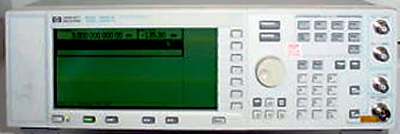
Keysight (Agilent) E4422A CALIBRATION and Keysight (Agilent) E4422A REPAIR

 
A calibration by Custom-Cal is performed by engineers with extensive OEM experience. We have the expertise and the necessary standards to perform the Keysight (Agilent) E4422A Calibration, onsite calibration may be available. We specialize in quick turnaround times and we can handle expedited deliveries upon request.

Need another Signal Generator?
Shop for Comparable Products on our
 used Signal Generator page

 
   Keysight (Agilent) E4422A (ESG-4000A)   Description / Specification:    
Keysight (Agilent) E4422A ESG 4000A 4000 MHz Analog RF Signal Generator

The HP E4422A ESG-4000A RF signal generator provides a wide range of digital modulation capabilities, in addition to a comprehensive feature set and excellent analog performance. Frequency range: 250 kHz to 4000 MHz with a resolution of 0.01 Hz. Switching speed: <45 ms with modulation on, <35 ms with modulation off. 3 operating modes are available: Step of frequency and power, and arbitrary list. Dwell time is 2ms to 60 seconds. Number of points: 2 to 401. The HP E4422A contains an extremely accurate reference oscillator, with a typical aging rate of <+/- 2ppm/yr or +/- 0.1 ppm/yr with high-stability option 1E5 option installed. Timebase reference output: 10 MHz, with an amplitude of >0.35 Vrms into a 50 Ohm load. External reference input frequency of 1, 2, 5, and 10 MHz +/- 10 ppm (1 ppm, Option 1E5). Output power range: +13 to -136 dBm at 250 kHz to 1000 MHz, +10 to -136 dBm at 1000 MHz to 3000 MHz, and a resolution of 0.02 dB. Reverse power protection: 25 Watts. Level accuracy: +/- 0.9 dB at +7 to -127 dBm, and +/- 2.5 dB at <-127 dBm. Atteniator hold range: >17 dB. Output switching rate: <25 ms typical and less than 210 ms with power search mode active. SWR: <1.4:1. at 250 kHz to 2000 MHz, <1.9:1 at >2000 MHz to 4000 MHz. Input impedance: 50 Ohms. The E4422A has 5 frequency bands. Frequency modulation on FM1 with 1 dB bandwidth: dc/20 Hz to 100 kHz; with 3 dB bandwidth: dc/5 Hz to 10 MHz. On FM2 with 1 dB BW: same as FM1; with a 3 dB bandwidth: dc/5 Hz to 1 MHz. Phase modulation has a maximum deviation of N x 90 rad, with a resolution of 0.1% of set deviation. Deviation accuracy (1 kHz rate): <+/-(5% of dev. + 0.01 rad). Amplitude modulation range (envelope peak <= max. specified power): 0 to 100%, with a 0.1% resolution. Modulation rates in a 3 dB bandwidth are dc/10 Hz to 10 kHz. Accuracy (1 kHz rate): +/- (5% of setting + 1%). Pulse modulation on/off ratio is >80 dB with rise/fall times of 150 ns. Minimum pulse width: 150 ns typical. Pulse repetition frequency with ALC on: 10 Hz to 250 kHz; ALC off: DC to 1.0 MHz. The internal modulation source provides FM, phase modulation, and AM modulation signals, and LF out, with a ate range for Sine of 0.1 Hz to 50 kHz; 0.1 Hz to 10 kHz for square, ramp, triangle. Resolution: 0.1 Hz. Frequency accuracy: 0.005%. LF out: 0 to 3 V peak into a 50 Ohm load with an output impedance of <1 Ohm. Available options: 1E5 (add high-stability timebase), and 1EM (move connectors to the rear panel.


Standard Calibration $1,025.00 *
Click on Logo for More Prices
*This is a Web introductory price for one calibration of the Keysight (Agilent) E4422A. Price does not in most cases include measurement performance data. Pricing does include NIST traceable calibration and issue of a calibration certificate and calibration label. Pricing may vary slightly due to volume and location of laboratory supporting calibration. Volume pricing may apply. On-site fees may apply depending on logistics, location and volume of work to be completed during the visit.


Related Bench Equipment Terms and Definitions. For a complete list go to our  Terms and Definitions Page.

Channel Bandwidth
Channel Bandwidth is the bandwidth over which power is measured. This is usually the bandwidth in which almost all of the power of a signal is contained.

Jitter
Jitter in technical terms is the deviation in or displacement of some aspect of the pulses in a high-frequency digital signal. Jitter is the time variation of a periodic signal in electronics and telecommunications, often in relation to a reference clock source. Jitter may be observed in characteristics such as the frequency of successive pulses, the signal amplitude, or phase of periodic signals. Jitter is a significant, and usually undesired, factor in the design of almost all communications links (e.g., USB, PCI-e, SATA, OC-48). In clock recovery applications it is called timing jitter.

Overshoot
Overshoot is the distortion that follows a major transition; the difference between the peak power point and the pulse-top amplitude computed as a percentage of the pulse-top amplitude.

Rise Time
Rise time refers to the time required for a signal to change from a specified low value to a specified high value, usually 10 and 90 percent of pulse-top amplitude (vertical display is linear power).


Please contact us for your Keysight (Agilent) E4422A CALIBRATION and/or Keysight (Agilent) E4422A ESG 4000A 4000 MHz Analog RF Signal Generator REPAIR

I'm interested in: 
Calibration Type (Select one):
Repair Information:
 Serial Number:

 Is there any physical damage?  
 If yes, describe:


What is the description of the problem?

How/when did the problem start?


 (*) Required Fields    For formal quote please fill in all fields.
Company:
From (Email):*
Contact Name:*
Country:*
Address 1:
Address 2:
City:
State/Territory/Province: *
Zip/Postal Code:
Phone:*

Comment: